Now booking: collection runs downtown, out to the beaches and across the river — start an estimate
Serving the Cape Fear coast
Repair & Restoration

Rug Repair & Restoration in Wilmington

Torn edges, missing fringe, grazing along the strip of rug under the bookcase, a corner the puppy decided was a chew toy, or a rug that spent three days on a wet floor while nobody was allowed back over the bridge. Most of it is fixable by hand.

Hand Work

Repairs That Disappear Into the Weave

Repair means rebuilding, not covering over. The rug goes back together in the order it was woven — foundation first, pile second, at the original knot density and matched to the original dye lot — so the repaired ground wears down in step with the rest of it instead of standing proud or sinking away. Done properly, you would have to be told where to look.

It is slow. A reweave is measured across square inches rather than feet, and it is done by hand at a loom because nothing else does it. The trade is worth making: most of what gets carried in here on the assumption that it is finished turns out not to be.

Every job starts with a free assessment and a straight verdict. If the repair is going to cost more than the rug is worth, you will hear that before anything is booked.

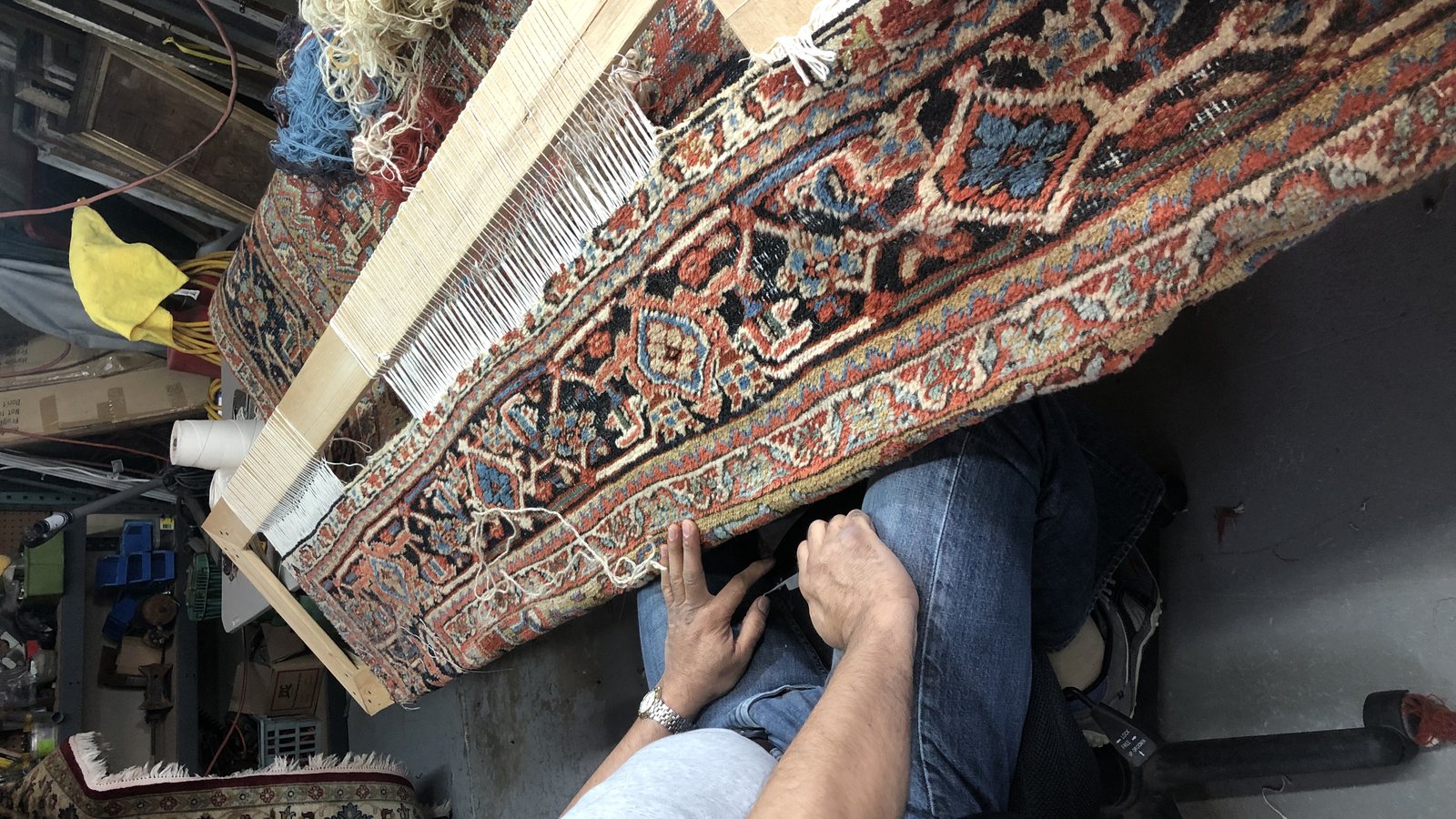
Matched wool being knotted back into an oriental rug at the repair bench
New wool going in knot by knot, rebuilding the foundation of an oriental rug.
What We Fix

Repair & Restoration Services

A frayed end at one extreme, a rebuilt border at the other.

Fringe Repair & Replacement

Fringe is structural — it is the warp itself, emerging at the two ends of the weave — so a fringe going to pieces is a rug losing its grip on itself. Ends are secured, the warps that have gone are put back, and the fringe is re-knotted or replaced to match what was there.

Edge Binding & Serging

Side cords take the wear the middle of the rug never feels — vacuum heads, furniture legs, and sand working sideways into the weave. When a cord splits, the row of knots beside it has nothing left to hold on to. Edges are rewrapped by hand in matched wool.

Reweaving & Hole Repair

Burns, tears and ground worn away to nothing are rebuilt a knot at a time — foundation before pile, with wool matched to the field for fiber, color and density.

Carpet Beetle & Moth Damage

Both eat wool from underneath, so by the time bare foundation shows there is usually something active. Which one you have matters: clothes moths want dark and undisturbed, while carpet beetle larvae will work away happily in an occupied room under a sideboard, and the adults fly in through screens in spring. We identify it, treat the infestation, then reweave the grazed areas.

Pet Damage

Chewed corners, clawed edges and urine that has eaten the dye from the base up. Everything is flushed out first, then the lost structure is rebuilt and the color put back where the original dye is beyond saving.

Color & Dye Correction

Tannin staining left by creek water, dye that travelled during a soaking or a bad cleaning, and the yellowing that follows when somebody reaches for household bleach on a wet wool rug. Color is rebuilt by hand wherever the fiber underneath is still sound enough to hold it.

Resizing & Reshaping

Rugs cut down to suit a room, and rugs blocked back square after years of going out of shape. Cut edges are properly finished, so what you get reads as a size rather than a survivor.

Backing & Foundation Repair

Hand-tufted rugs where the latex has crumbled, brittle cotton warps in antiques, and rugs that will not lie flat because the foundation has failed underneath. Structure is put right first; appearance is the second job, never the first.

Rug Pads & Prevention

A great many of the repairs we do began with a cheap pad. PVC and latex-foam pads come apart in heat and humidity, and the residue bonds to the back of the rug and the floor finish at the same time. We fit breathable, non-adhesive pads sized to the rug — which matters most in a climate where the back of the rug is the part that needs to dry.

Local Conditions

What Wilmington Air Does to a Rug’s Foundation

Wilmington is damp 211 days a year, 57.8% of the calendar, which is near the top of this network — but the longest unbroken damp run in the five-year record is only 39 days. High total, broken delivery. A rug that is wetted and dried dozens of times a year fails differently from one that is simply held wet, and the repairs reflect it.

211
Days a year at or above 75% relative humidity
39
Longest unbroken damp run, in days
16
Nights a year at or below freezing
55.6
Inches of rain a year

High total, broken runs

211 days a year above the mold threshold with a longest unbroken run of 39 days means the air here keeps letting go and taking hold again, and the daily maximum reaches 95% on 42.9% of days.

Cotton swells as it takes up moisture and shrinks as it gives it back; wool moves less, and later. Cycling that joint dozens of times a year is what loosens side cords and works fringe knots open.

So rugs arrive here off-square and rippling more often than they arrive rotted, and the fix is blocking and edge work rather than reweaving.

Where the house puts the rug

Historic District, Wrightsville Beach and Carolina Beach include houses raised on piers, which ventilates the underside of the floor but does not dry it.

The air moving under a raised floor is outdoor air, so the underside of the rug tracks outdoor humidity directly — and outdoor humidity here is at or above the mold threshold 211 days a year.

Landfall, Porters Neck and Leland sit on or near the water, which raises the local moisture load above what a regional figure implies.

Ground water close to the surface keeps the soil under a floor wet through the dry parts of the year, so the 154 days a year when the air is below the mold threshold do less recovering than they look like they should.

The oldest housing on the collection route goes back to the 1870s, and construction of that age was not built to keep ground moisture out of the rooms above it — which is worth remembering before blaming a rug's condition on the rug.

What that actually sends in for repair

Foundation loss, not surface wear

Cellulose held damp loses strength, and 39 unbroken days above 75% is long enough for it to matter.

A foundation going that way gives no cosmetic warning, so the test is mechanical: fold a corner and see whether it flexes or crackles, and pull gently on a fringe tassel to see whether it is still anchored in anything.

Fringe, because fringe is the foundation

Fringe is the warp ends of the rug, not a trim, so 211 days a year of damp working on cotton warps shows up there before it shows up anywhere else.

Once the ends let go the rug starts unravelling from the edge inward, which is why a fringe that has begun to shed is worth dealing with while it is still a fringe job.

Dyes that moved before we saw the rug

155 days a year reach 80% relative humidity, where a wet rug stays wet, and an unstable dye that is kept wet and warm will travel.

Most of what looks like a stain on an old rug is dye that migrated during an earlier soaking, and it is corrected by hand where the fiber is still sound rather than by washing harder.

Figures above are from the ERA5 reanalysis record for the five years from 2021 through 2025, taken at the center of the the Cape Fear coast service area. If what you are seeing on your rug matches any of this, send photographs and we will tell you which of these it is.

Wet Rug Service

Storm, Flood & Water Damage Rug Restoration

A creek that came up over the yard, the tide backing out of a downtown storm drain, a roof that let go in a named storm, or a supply line behind a washing machine. The rug on that floor is now on a clock.

Why the number of days matters more than the depth

Wool comes through a soaking better than almost anything else on a floor. It is the days afterward that finish it. In a warm room a saturated foundation is colonized by mold in roughly forty-eight hours, and once it has reached the base of the knots no vacuum, spray or fan brings it back out. On this coast the room is always warm enough, and after a storm it usually has no power either. Meanwhile the unstable dyes are moving, the cotton is rotting, and whatever the water carried in is curing into the fiber.

That is why the honest question after an island evacuation is never how bad it looked on the day — it is how many days it sat before anyone was allowed back across the bridge. And blackwater flooding adds a second clock of its own: the tannin and humic acid that make swamp water the color of tea behave like a dye, and given warm wool and a few hours they set. Both problems need the same first move, which is immersion. A fan aimed at a wet rug is not restoration. It dries the face of the pile, locks everything else into the foundation, and gives you three good weeks before the rug tells you the truth.

What to do before we arrive

  • Get it off the wet floor and out from under the furniture. Wooden legs sitting on damp pile will bleed stain into it inside a few hours.
  • Do not bag it or roll it tight in plastic. Sealed wet wool is an incubator. Loose and airy wins.
  • Photograph it wet and in place before anything is moved. That is the evidence a claim runs on.
  • Keep household bleach and fogging products away from it. Hypochlorite attacks wool protein directly and that damage cannot be undone.
  • If you cannot get back to the island yet, ask a neighbor or your property manager to lift it and photograph it. Days matter more than distance.

The restoration sequence

  • Priority collection. Storm-wet rugs are pulled forward of routine washing wherever the schedule can take them.
  • Category assessment. Clean supply water, gray water, brackish tidal water and fresh blackwater flooding are four different jobs, and which one you have decides the method.
  • Extraction and full flush. Salt, silt and contamination are carried out through the foundation instead of being sealed in behind a dry face.
  • Tannin treatment and pH correction. Swamp-water staining is addressed as the dye chemistry it is, and the wool is brought back off acid afterwards.
  • Antimicrobial treatment. Taken through the whole rug, front and back, before drying is allowed to begin.
  • Monitored flat drying. Filtered air over a flat rug, metered until the readings level off, so nothing is delivered damp.
  • Structural repair. Rotted foundation and missing pile are rewoven once the rug is dry and stable.
  • Claim documentation. A photographic record from intake onward, and a written condition report for your carrier.
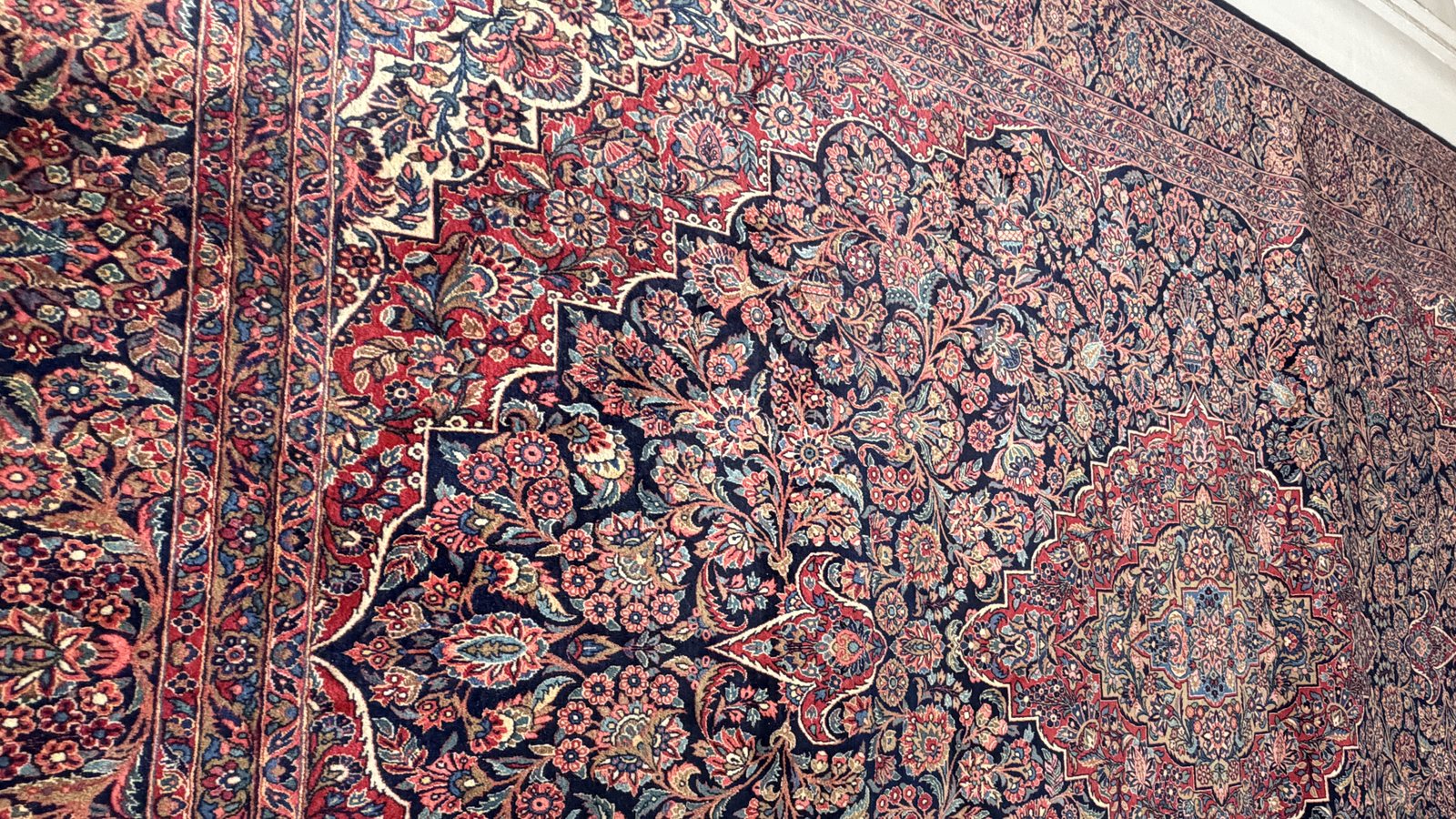
A rug photographed flat after water-damage recovery, field color brought back through the pile
How It Works

From First Message to Delivery

Photos or Collection

Send pictures of the damage, or we collect the rug at no charge anywhere in New Hanover and Brunswick counties.

Assessment & Quote

Damage is mapped, materials are identified, and you get a written price with the options in front of you. Nothing starts without your say-so.

Clean First

A repair goes into a clean rug, not a dirty one. New wool knotted into a soiled field shows up as a patch inside a year.

Materials Matched

Wool is matched to the original by fiber, weight and dye lot, and tested against the field before it goes anywhere near the loom.

Hand Repair

Foundation rebuilt, pile knotted back in at the original density, then sheared level with the wool around it.

Final Check & Return

Groomed, checked against the intake photographs, and brought back to your floor.

Questions

Repair & Restoration FAQ

Is my rug worth repairing?
You get told straight, before anything is committed. Repair is worth it when the rug has value to you or on the market, and when the foundation is still holding together. If the work would cost about what the rug is worth, we say so and stop there.
How long does rug repair take?
It depends on how much area has to be rebuilt, because a reweave is hand work counted in square inches. You get the timeline with the written quote, up front. Anything that came in wet is handled out of sequence, because with those the delay is the damage.
My rug sat wet for days after the storm. Is it gone?
Not necessarily, and this is the question we most want people to ask before they drag anything to the curb. What decides it is whether the foundation is still sound — not how it smells, and not how it looks after a week in a shut-up house. Send photographs of the front, the back and the ends. If it can be flushed, decontaminated and dried properly it usually can be saved, and if it cannot we will tell you that instead of charging you to find out.
Someone put bleach on it. Can that be reversed?
The color sometimes; the fiber no. Wool is a protein, and household bleach breaks the bonds that give it strength, so bleached wool goes yellow and then brittle. If the damage is localized, the affected area can be rewoven with matched wool and the surrounding color corrected. If a whole rug was fogged or soaked, what is left is weak everywhere, and there is nothing sound to anchor a repair to.
Will the repair be visible?
After grooming, a good reweave is genuinely hard to spot. Wool is matched by fiber, dye lot and knot density, and the foundation is rebuilt before the pile, so the repaired ground wears in step with the field instead of sinking or standing proud.
Do you work with insurance claims?
Yes, and it is routine here after a storm. The rug is photographed at intake and throughout, and you get a written record of damage, treatment and value impact to file with the claim.
My rug ripples and will not lie flat. Can that be fixed?
Usually. Buckling comes from an uneven foundation, from bad drying somewhere in the rug's past, or from years on a pad that was too soft or has started to break down underneath it. The fix is a wash, blocking back square under tension, and foundation repair wherever it has stretched or torn.

Send Us a Photo. We Will Tell You Straight.

Free assessment on anything you bring us, and an honest answer about whether it is worth repairing.

Rug Cleaning

The six-stage hand wash step by step, and why cleaning a rug in the room it lives in fails on this coast.

Cleaning process

Cape Fear Care Notes

Coastal damp, rental changeovers, marsh mud and flood water — what rug owners here need to know.

Care notes

Book a Collection

Collection and delivery included across New Hanover and Brunswick counties.

Contact us
Start a Free Estimate Service Areas