Now booking: collection runs downtown, out to the beaches and across the river — start an estimate
Serving the Cape Fear coast
Rug Cleaning

Professional Rug Cleaning in Wilmington

Every rug is washed by hand, off site — not bonneted over in a changeover window, and never run through a machine that treats silk like a doormat.

The Difference

Why Rug Cleaning Is Not Carpet Cleaning

Fitted carpet is stretched and tacked over a pad. Its backing seals it, water drains downward into the pad, and the whole thing tolerates rough handling. A rug is the opposite proposition: open on both faces, lying loose on your floor, and in a great many cases held together by hand-tied knots on a cotton warp older than the house it sits in.

Cleaning one in place gets three things wrong at once. Soil at the base of the pile is pushed deeper rather than lifted out. Water goes into a foundation that has no way to release it, in a county where the outdoor air carries no drying power for weeks at a time. And the rinse never actually happens, because rinsing needs somewhere for the water to go — so the detergent stays in the rug, turns tacky, and starts collecting the next month's grit. That is the whole reason a rug on a rental changeover schedule gets dirtier faster every season.

Washing it elsewhere avoids all of that. The rug leaves the house, the dry grit comes out before any water is introduced, it is washed and flushed until the water runs clear, and it dries flat under moving air. Then it comes back.

Learn how rugs are constructed

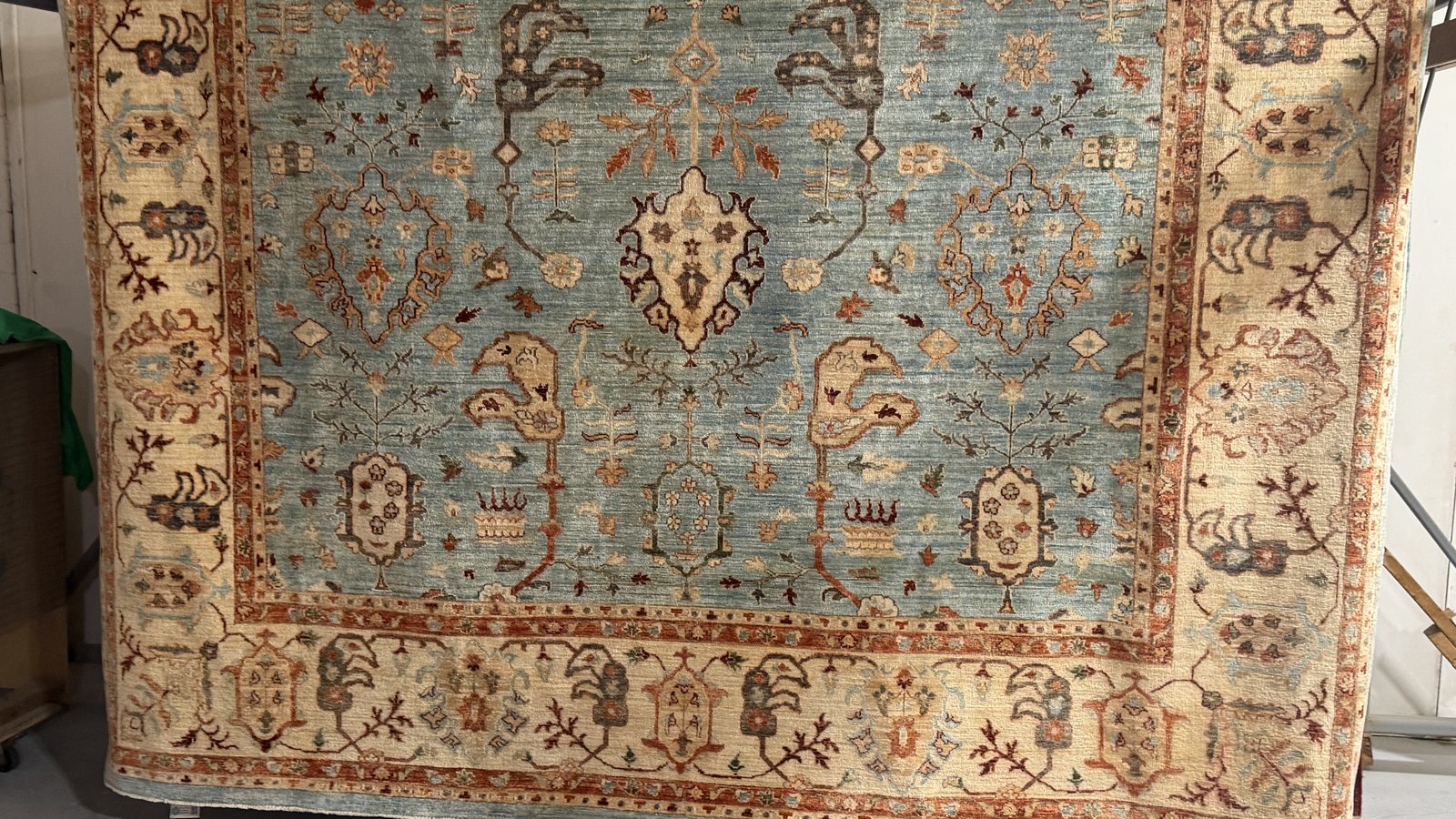
A washed Oushak rug hanging to dry, pile lifted
A finished wool rug on the drying rack.
Step by Step

The Cleaning Process

Six stages, same order every time. Rugs get wrecked when one of them gets left out.

Inspection & Dye Testing

The rug is spread flat and examined front and back. We work out the fiber and the construction, note the damage already there, and swab every color to check that the dye will stay put. All of that sets the wash plan, and you get told what turned up.

Dry Grit Removal

Before water, the dry material comes out. A rug on this coast holds beach sand, yard grit and dried marsh silt down at the foundation. Compressed-air dusting and controlled beating shift it. No other stage does more for how many years a rug has left in it.

Pre-Treatment

Spots, pet accidents, mildew blooms, tannin staining and traffic lanes are treated one by one, with chemistry matched to the fiber and given time to work. Wool and silk are held at neutral pH; synthetics can take more.

Full Immersion Wash

Under water, and washed by hand with soft brushes worked along the lay of the pile, so that loosened soil floats away instead of being rubbed back in. Immersion is also the only thing that lifts old detergent residue back out of a pile. Fragile rugs and unstable dyes get low-moisture handling instead.

Rinse & Controlled Drying

Flushing keeps going until the water comes off clear, because detergent left in a rug is a magnet for the next lot of sand. Water is then extracted mechanically and the rug dried flat in filtered moving air, out of the sun, which fades dye and hardens wool.

Grooming & Final Check

The pile is groomed back into lay, the fringe cleaned and straightened, and the rug checked against the intake notes. Anything left unresolved is flagged before it goes into the wrap.

Recent work

Before and After

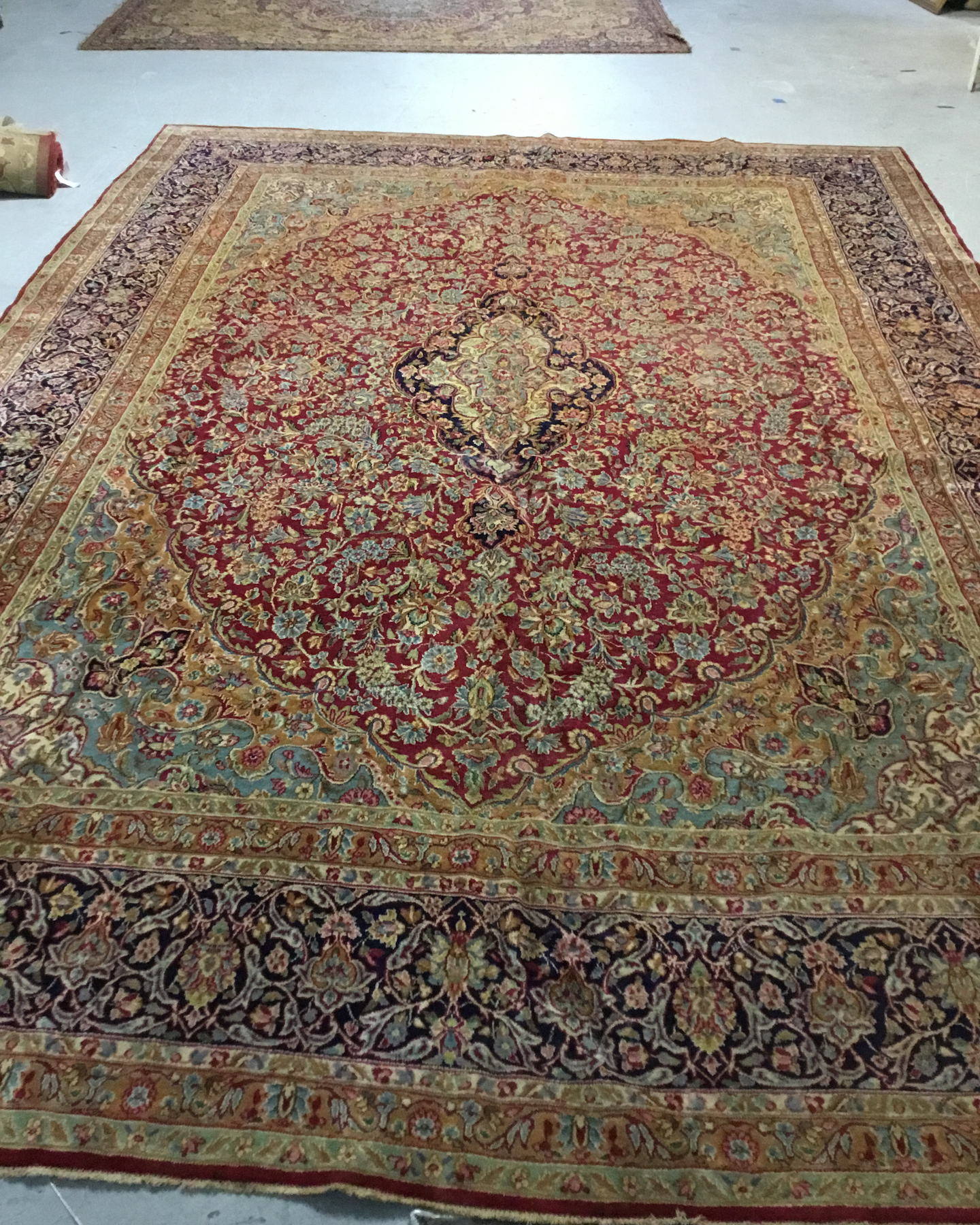
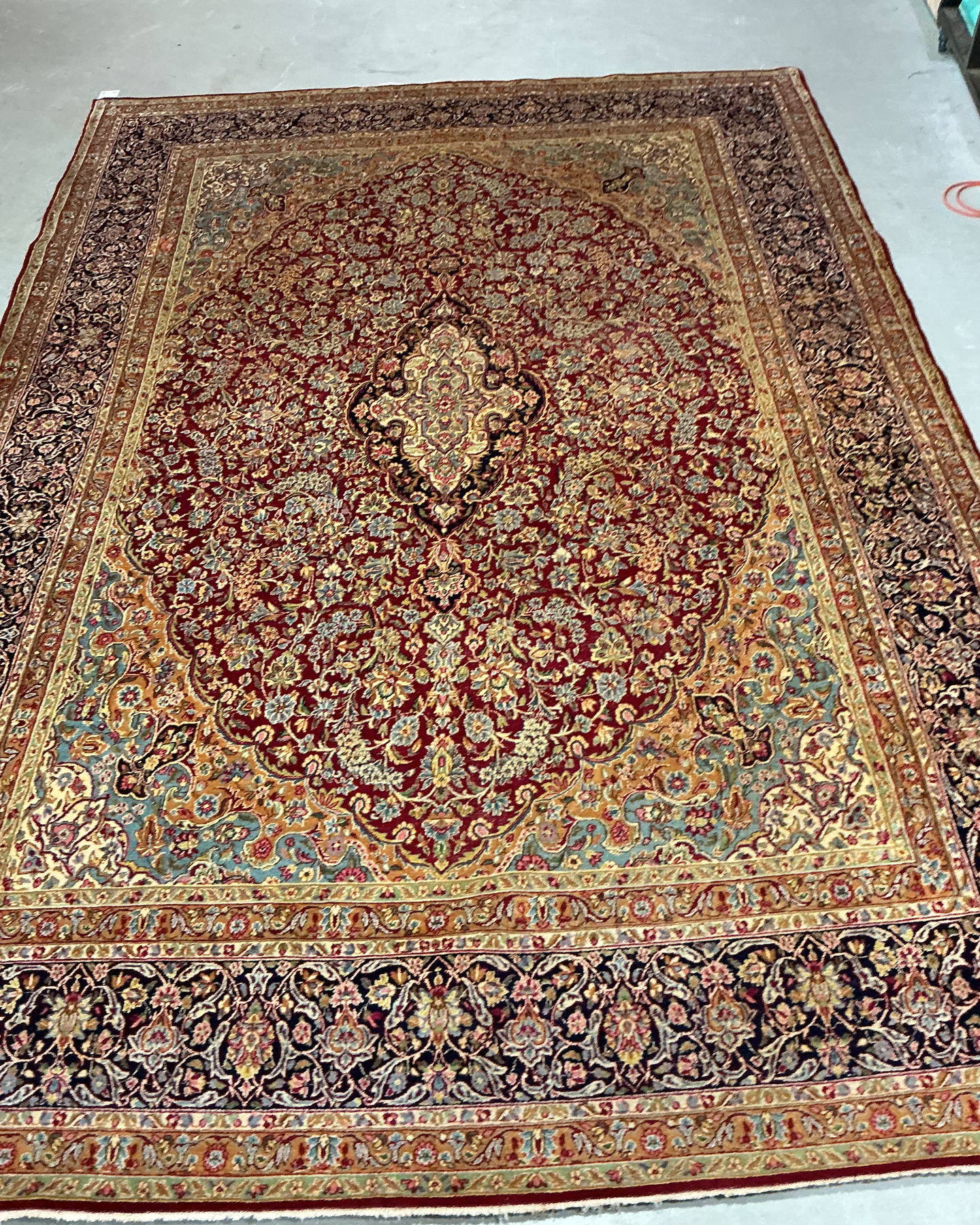
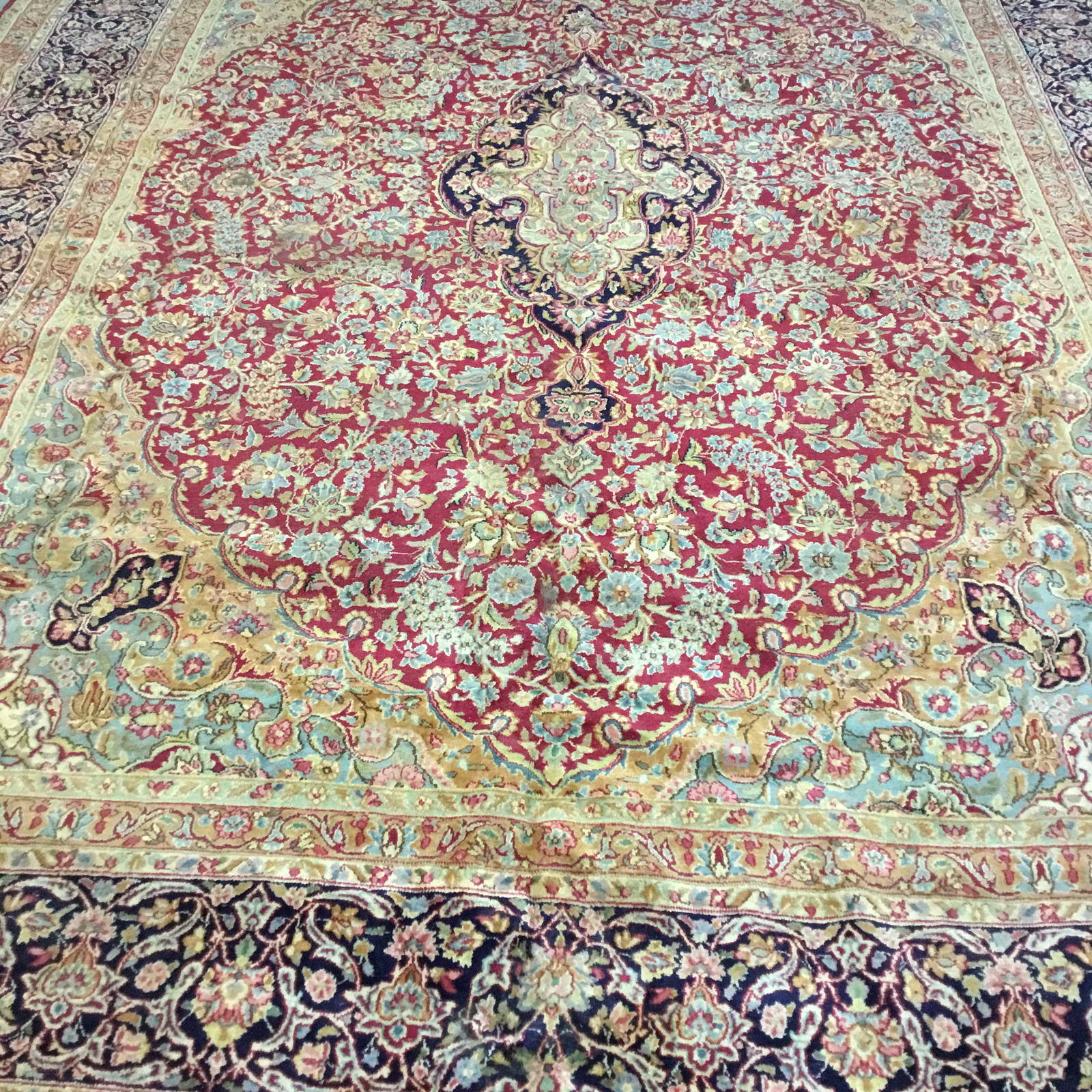
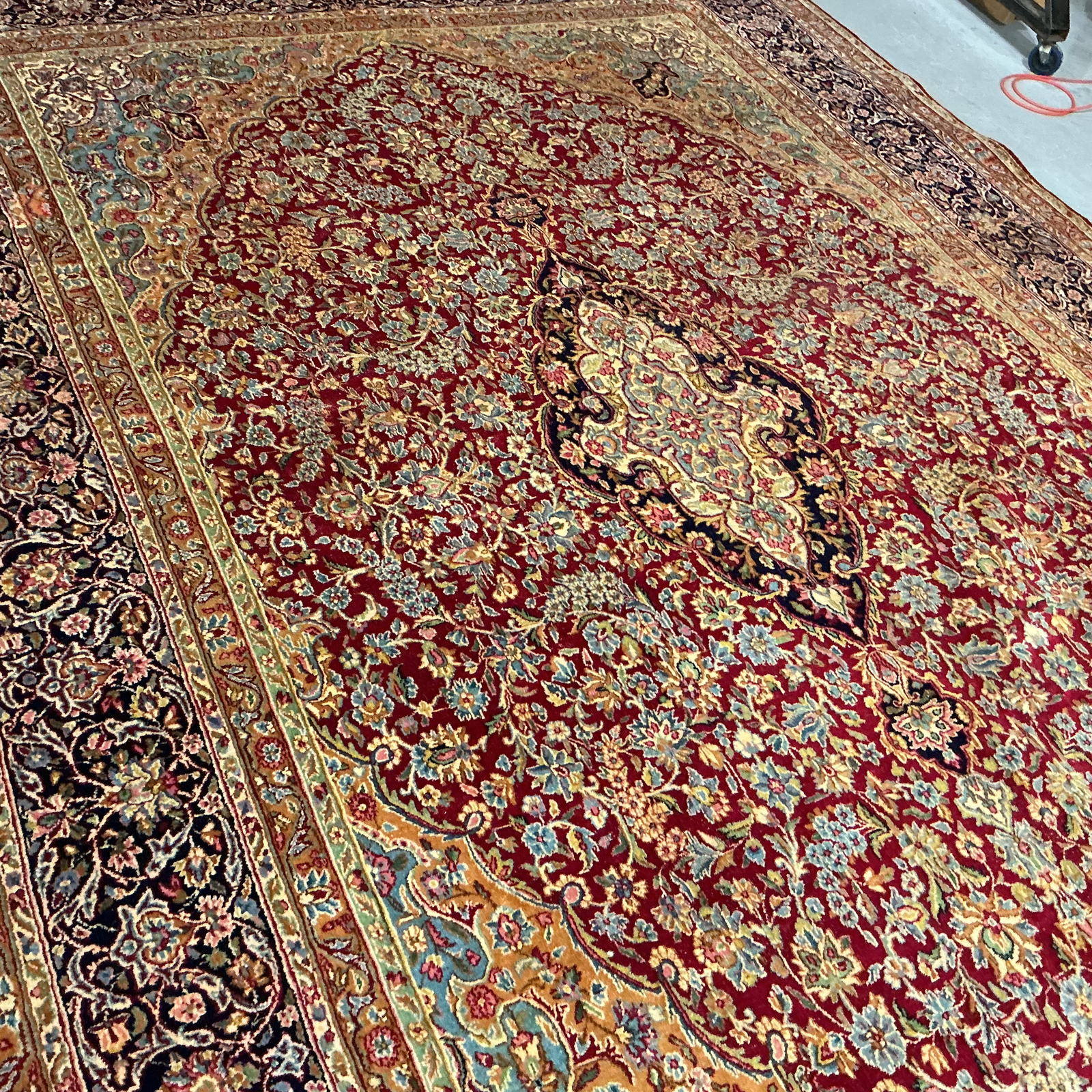
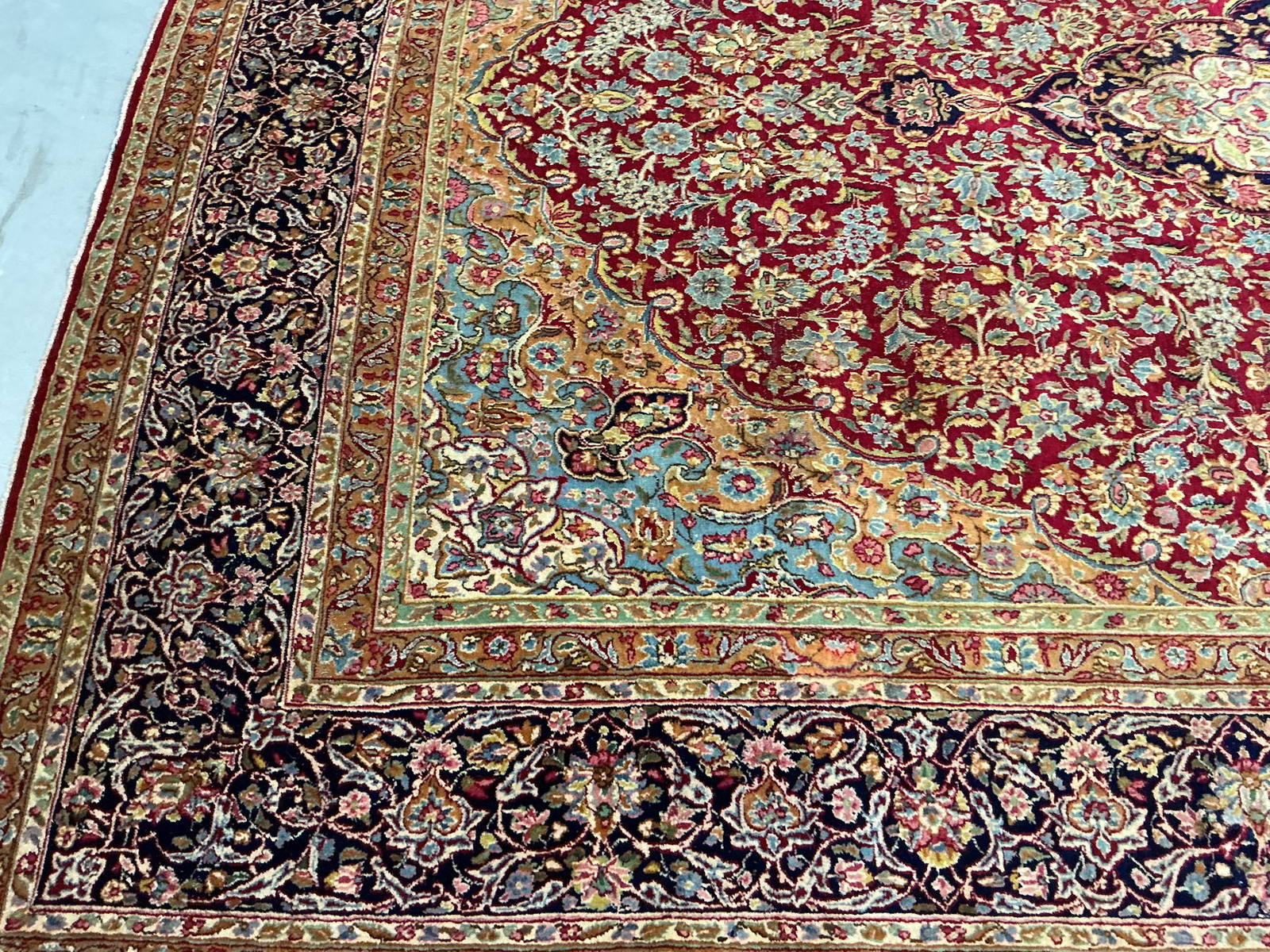
One hand-knotted Persian rug, photographed before and after cleaning.

Before
Hand-knotted Persian rug before cleaning, the deep red field and blue-green floral tracery muted and greyed
After
The same rug after cleaning, with the red field, gold corner spandrels and blue-green florals showing clearly
A hand-knotted Persian, before and after cleaning.
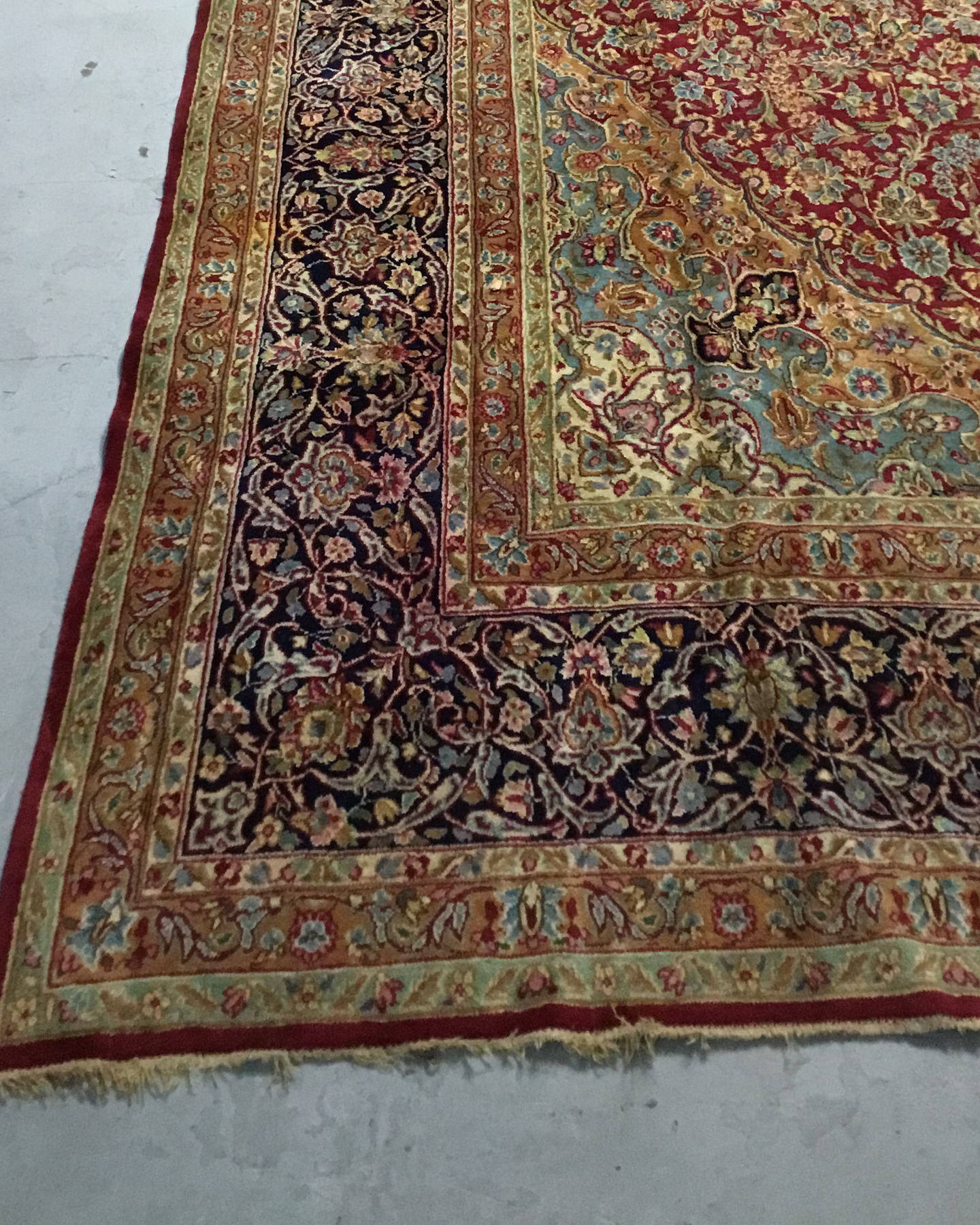
Before
Corner of the same rug before cleaning, the navy border and ivory fringe dulled and flattened in tone
After
The same corner after cleaning, with the navy border, gold guard bands and ivory fringe distinct again
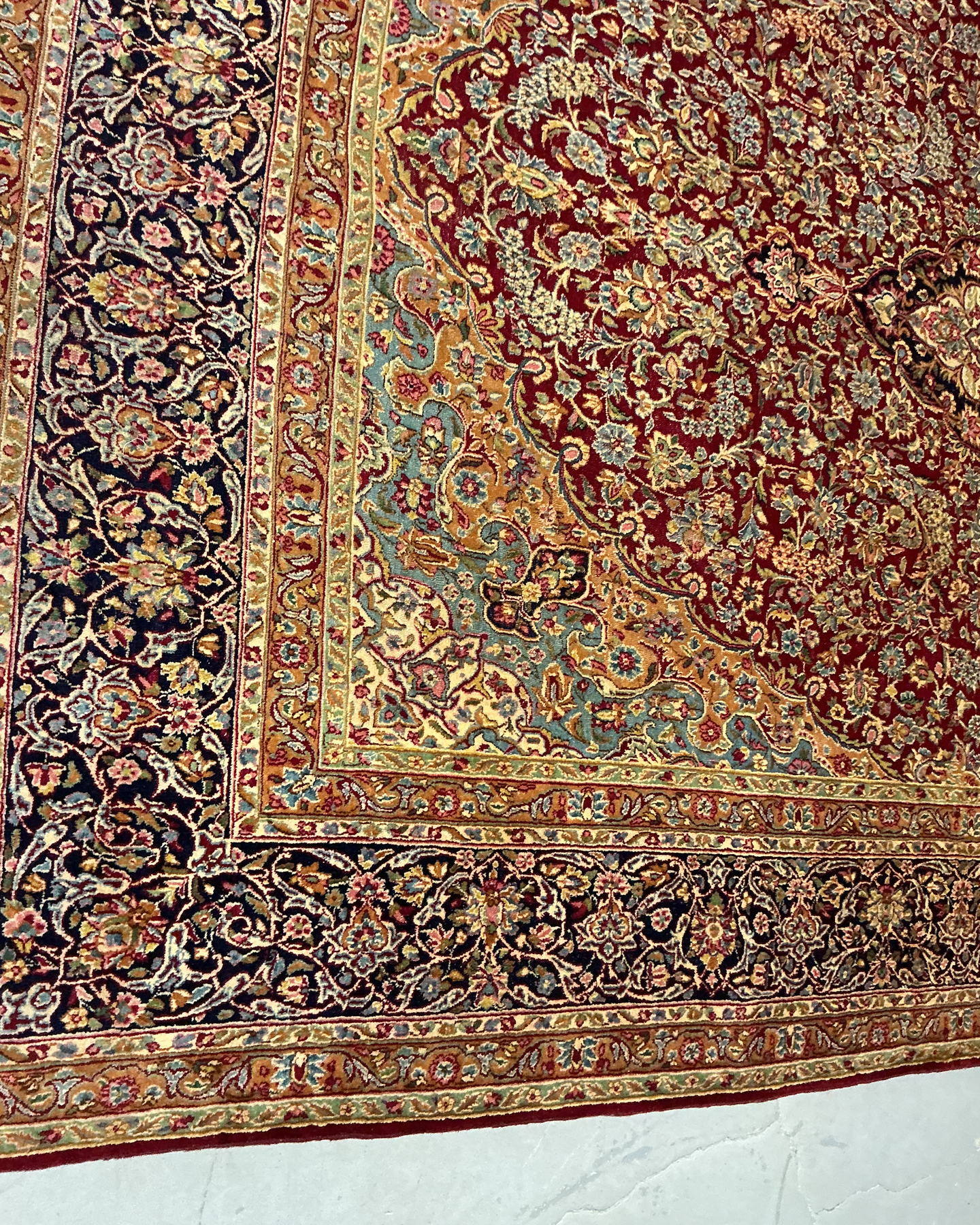
Corner detail — border, guard stripes and fringe.
Before
Centre of the same rug before cleaning, the navy medallion and red field hazy and low in contrast
After
The same medallion after cleaning, the cream and gold palmette reading crisply against the navy and red
The central medallion and the field around it.
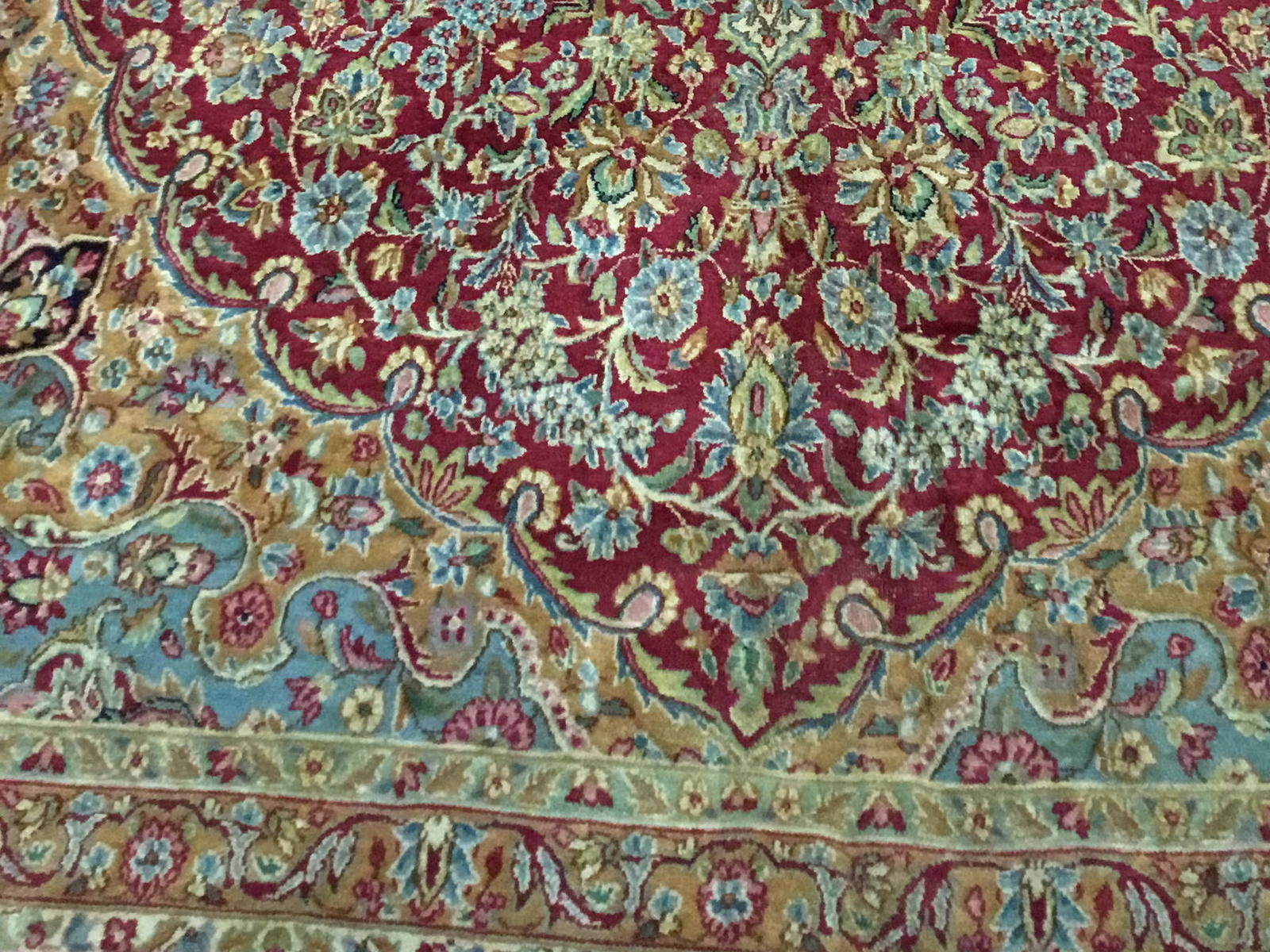
Before
Field meeting border on the same rug before cleaning, the blues and pinks greyed and indistinct
After
The same section after cleaning, with the pale blue scrollwork and pink florals separated and legible
Where the field meets the border.
Local Conditions

Drying a Rug in Wilmington Air

Wilmington is above the mold threshold 211 days a year, 57.8% of the calendar, but in stretches of up to 39 days rather than one long season. That means there are drying windows — and it means a rug that is washed badly gets a fresh chance to smell every time one closes.

75.1%
Mean relative humidity, five-year average
155
Days a year at or above 80% relative humidity
39
Longest unbroken damp run, in days
133
Days a year with measurable rain

Why it cannot dry where it lies

A rug washed in the room it lives in has to give its water back to that room's air, and for 39 days at a stretch Wilmington air is already at or above 75%.

Air that damp takes water out of a rug slowly at best, which is the whole problem with in-home wand cleaning here: the pile dries, the foundation does not, and the rug smells fine for a few weeks and then does not.

The pile is not the part that matters

Wool will carry close to a third of its own weight in water without feeling wet, and on the 155 days a year that reach 80% relative humidity it is doing exactly that.

So a rug that feels dry to the hand can have a loaded foundation, which is why drying is taken to moisture readings rather than to touch, and why the back of a rug tells you more than the front.

Rain, and the trip to the workshop

133 days a year here see measurable rain, totalling 55.6 inches, so a rug leaving the house is wrapped for the weather rather than for the look of it.

It is also why we would rather collect a wet rug than have it wait: a rug that is already damp when it is rolled is in the worst possible condition for sitting still.

The floor the rug goes back onto

In Historic District, Wrightsville Beach and Carolina Beach, where houses are raised on piers, the underside of the floor sees outdoor air all year.

That means a returned rug re-equilibrates to outdoor humidity rather than to the conditioned room above it, which is worth knowing when choosing when to put it back down.

Landfall, Porters Neck and Leland sit close to water, and a rug from a waterside room starts wetter than the same rug five miles inland.

That shows up as odor returning rather than as visible soil, because the source is moisture in the structure rather than dirt in the pile.

Housing on this route starts in the 1870s, so a fair number of these rugs are drying onto floors that are older than any vapor barrier — a detail worth settling before the rug comes back.

Humidity, rainfall and temperature figures are from the ERA5 reanalysis record for the five years from 2021 through 2025, measured at the center of the the Cape Fear coast service area.

What We Accept

Rug Types We Clean

Everything that goes on a floor has a right method. Each type is handled its own way.

Fiber and construction, with the treatment each one takes.
Rug type How we handle it
Hand-knotted Persian & oriental Dye-tested first, then a full immersion wash with the fringe done by hand. Antiques get reduced agitation and a longer dry.
Wool area rugs Neutral-pH immersion wash. Lanolin is kept rather than stripped out, because it is what makes wool resist soil in the first place.
Silk & art silk (viscose) Low-moisture specialist cleaning only. Viscose yellows and stiffens if it takes too much water, so it stays out of immersion.
Cotton flatweaves & dhurries Moisture is controlled closely and the rug dries under tension, so a reversible weave will not pucker or shrink.
Jute, sisal & seagrass Dry methods or very low moisture only. Plant fiber stains from its own water, and in a coastal house it is the first thing to mildew.
Hand-tufted rugs Washed carefully around the latex layer. That adhesive is what fails as the rug ages, and it is where the old-glue smell comes from.
Machine-made synthetics Polypropylene, nylon and polyester take a full wash and a stronger pre-treatment. Good value, and the usual choice for a rental.
Shag, hides & sheepskin Specialty handling, agents matched to the fiber, and hand finishing to get the loft back.
Local Specialties

Problems Wilmington Rugs Actually Have

Rental Turnover Residue

A rug on a Saturday-to-Saturday calendar gets treated in the room, in a hurry, with no rinse. Every one of those passes leaves surfactant behind, and surfactant residue is tacky — it grabs the next fortnight's sand and holds it against the knots, so the rug re-soils faster after each clean than it did before. Owners read that as heavy use and clean more often, which accelerates it. The residue only leaves in immersion, flushed until the water runs clear, and after that the rug behaves normally again.

Storm Water & Creek Flooding

Two different floods reach rugs in this county. Brackish tidal water pushes back through downtown storm drains and carries whatever was in the street. Fresh blackwater off the swamps west of the river is stained with tannin and mildly acidic, and tannin sets into warm wool like the dye it is — which is why a rug that took creek water comes back a uniform dull brown that ordinary washing will not shift. Each needs its own treatment, and both need flushing rather than drying.

Pet Urine & Marsh Mud

Urine salts stay down in the foundation, pull moisture back out of the air every time the dew point climbs, and burn dye if they are left. Dogs on this coast also bring in creek mud, which is a fine anoxic clay rather than grit: it wicks into wool wet, dries bonded to the fiber, and brings its sulfide smell with it. Neither vacuums out. Both are flushed out, and discoloration is put right where the dye underneath is still there.

How the Work Is Set Up

Washed Off Site, Flat

Collected and washed away from the house, then dried flat in moving air — never hung wet, never dried on your floor.

Safe for Every Fiber

Fiber identified and dyes tested before any water. Wool and silk get neutral chemistry, and stronger treatment goes on only where it is safe.

Collection & Delivery

New Hanover and Brunswick counties, both directions, no charge. We move the furniture off the rug too.

Plain Answers

You get told what we find, what it costs, and what is not coming out. Nothing happens until you have agreed to it.

Questions

Frequently Asked Questions

How long will the rug be off the floor?
The timeline comes with the quote, before anything starts. Drying is the slow part and it is slower here in high summer, because a rug stays on the drying floor until it is genuinely dry. Heavy pet contamination, tannin staining, dye bleeding or repair work all add time, and you are told that at the beginning.
Can you work around a rental changeover?
Yes, and it is a common arrangement on the islands. Tell us the changeover day in the form and we will work to it, or collect out of season when the calendar is open. Rugs are regularly collected through a property manager or a cleaner with access rather than from the owner directly. Condition is photographed at collection either way, so the state the rug left in is documented.
Do you clean all rug types?
Hand-knotted Persian and oriental rugs, wool, silk, cotton flatweaves, jute and sisal, hand-tufted rugs, machine-made synthetics, hides and shag. Each fiber gets its own wash, and a few — antique silk especially — are low-moisture only.
Is pickup and drop-off really at no charge?
Yes, throughout New Hanover and Brunswick counties. We collect the rug, move the furniture off it, and return it rolled and ready to lay. No charge either way, bridges included.
Will washing shrink the rug or run the colors?
Not when the wash suits the rug. Every color is dye-tested before water touches the pile, and where a dye is unstable the method drops to low moisture or gains a dye-setting step. Shrinkage comes from over-wetting a cotton foundation and drying it under tension, which is the thing controlled flat drying is designed to avoid.
How often does a rug need washing on this coast?
Broadly, twelve to eighteen months for a rug in a main living area. That is shorter than the usual national advice and the reasons are local: close to fifty-six inches of rain spread across every month of the year, dew points in the seventies through the summer, sand and creek mud coming in on bare feet, and a hurricane season that runs half the calendar. A rug in a rented beach house is on a different schedule again — once a season is reasonable, and once ever is what we usually find. A guest room or a lightly used rug will stretch to two or three years. Anything that has been wet is dealt with now, not eventually.
Can the musty smell be got out of a rug?
Usually. That smell is microbial growth in the foundation and not on the surface, so it comes out in a full-immersion wash and is followed with an antimicrobial. Deodorizing sprays only mask it, and it returns with the next humid stretch — which here is next week. If the foundation has begun to rot, that is a repair question as well as a cleaning one, and we will say which one you are looking at.
What does rug cleaning cost?
Priced by the square foot and set by fiber, construction and condition, since a machine-made synthetic and a hand-knotted silk are not the same job at all. The quote comes before any work, the estimate is free, and there are no additions when the rug comes back. Send the details across and we will come back with a number.
Get In Touch

Book a Collection

Tell us roughly what you have and where you are, and it goes on the run.

  • Service area
    New Hanover and Brunswick counties, North Carolina
    Collection & delivery included throughout
  • Hours
    Mon–Sat: 9:00 AM – 5:00 PM
    Sunday: Closed

Free Cleaning Estimate

Up to 6 photos. Close-ups of any damage, stains or wear help us quote accurately without a visit.

Ready for a Cleaner Rug?

Free estimate, collection included, and a rug that comes home looking like itself again.

Rug Repair & Restoration

Fringe, binding, insect grazing and reweaving — what is worth fixing, and what the job looks like.

Repair services

Water Damage Recovery

What to do in the first forty-eight hours after a rug takes storm water, creek water or a leak.

Water damage

The Rug Owner’s Guide

Knots, fibers, construction, and how to care for all of it through a Cape Fear summer.

Read the guide
Start a Free Estimate Service Areas